
Syllabus#
Course Information#
Instructor(s): Michael McNeil Forbes
m.forbes+581@wsu.eduCourse Assistants:
Office: Webster 947F
Office Hours: F2-4 (F12-5 by appointment): iSciMath Coffee Hours in Webster 1243 (Band room).
Course Page: https://schedules.wsu.edu/sectionInfo/&prefix=Phys&year=2024
Class Number: 581
Title: Phys 581: Estimate Anything: The Art of Play in Science
Credits: 3
Recommended Preparation:
Meeting Time and Location: MW, 2:00pm - 4:00pm, Webster 941, Washington State University (WSU), Pullman, WA
Grading: Grade based on participation and project.
Prerequisites#
This course is intended for a broad audience. As such, the only formal background assumed is a strong background in calculus and linear algebra as described in Linear Algebra.
Familiarity with undergraduate physics sciences will be useful, but is not required.
Additionally, you should bring to the course expert knowledge in at least one domain – i.e. your core program – and a passion to learn about the world in general.
Students will be expected to check their work numerically, so familiarity with a language like Python and the NumPy and SciPy would be helpful. Instructions on how to use the online CoCalc computational platform will be provided, so students do not need to provide their own software, compilers, etc.
Textbooks and Resources#
Required#
 |
 |
 |
 |
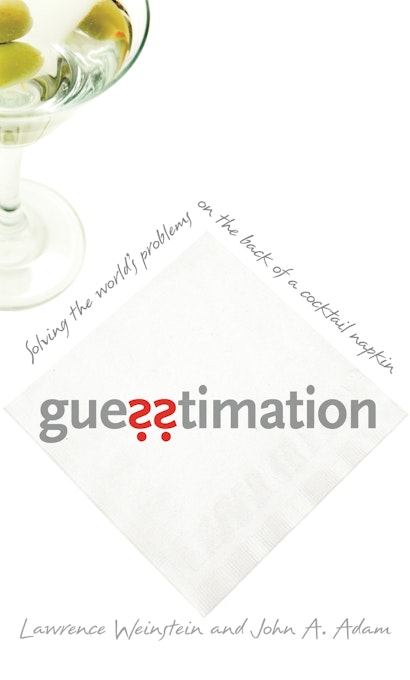
- Weinstein and John, 2008: “Guesstimation: Solving the World’s Problems on the Back of a Cocktail Napkin”
This is the informal textbook for the course. It is available through the WSU Library electronically through ProQuest (requires WSU sign-in). It is easy to read but the examples are out of date. Use it for the techniques and advice more than the questions.
- Weinstein, 2012: “Guesstimation 2.0: Solving Today’s Problems on the Back of a Napkin”
This is a followup with more relevant problems. It is available through the WSU Library electronically through ProQuest (requires WSU sign-in).
- Mahajan, 2014: “The Art of Insight in Science and Engineering: Mastering Complexity”
This is the main technical textbook for the course. It delves more deeply into technical aspects of scientific estimation, and requires more knowledge of physics. However, the general strategies are more important and generally applicable, and will form the basis for the technical aspects of the course. It is available online.
- Munroe, 2014: “What If? Serious Scientific Answers to Absurd Hypothetical Questions”
The class project is to write an article in the spirit and style of this book. It is available through the WSU Library electronically through ProQuest (requires WSU sign-in).
Additional Resources#
 |
 |
 |
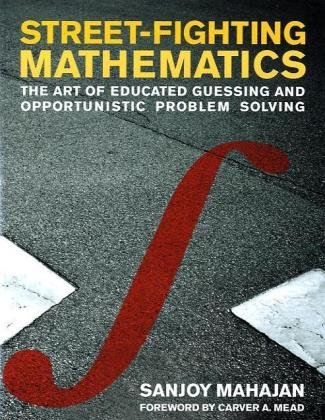
- Mahajan, 2010: “Street-Fighting Mathematics: The Art of Educated Guessing and Opportunistic Problem Solving”
An earlier book by Mahajan aimed at mathematics. It is available online.
- Olshanii, 2013: “Back-of-the-Envelope Quantum Mechanics With Extensions to Many-Body Systems and Integrable PDEs”
For physicists: demonstrates more sophisticated techniques for quickly estimating results in quantum mechanics – usually seen as a challenging field requiring lengthy calculations. It is available through the WSU Library electronically through ProQuest (requires WSU sign-in).
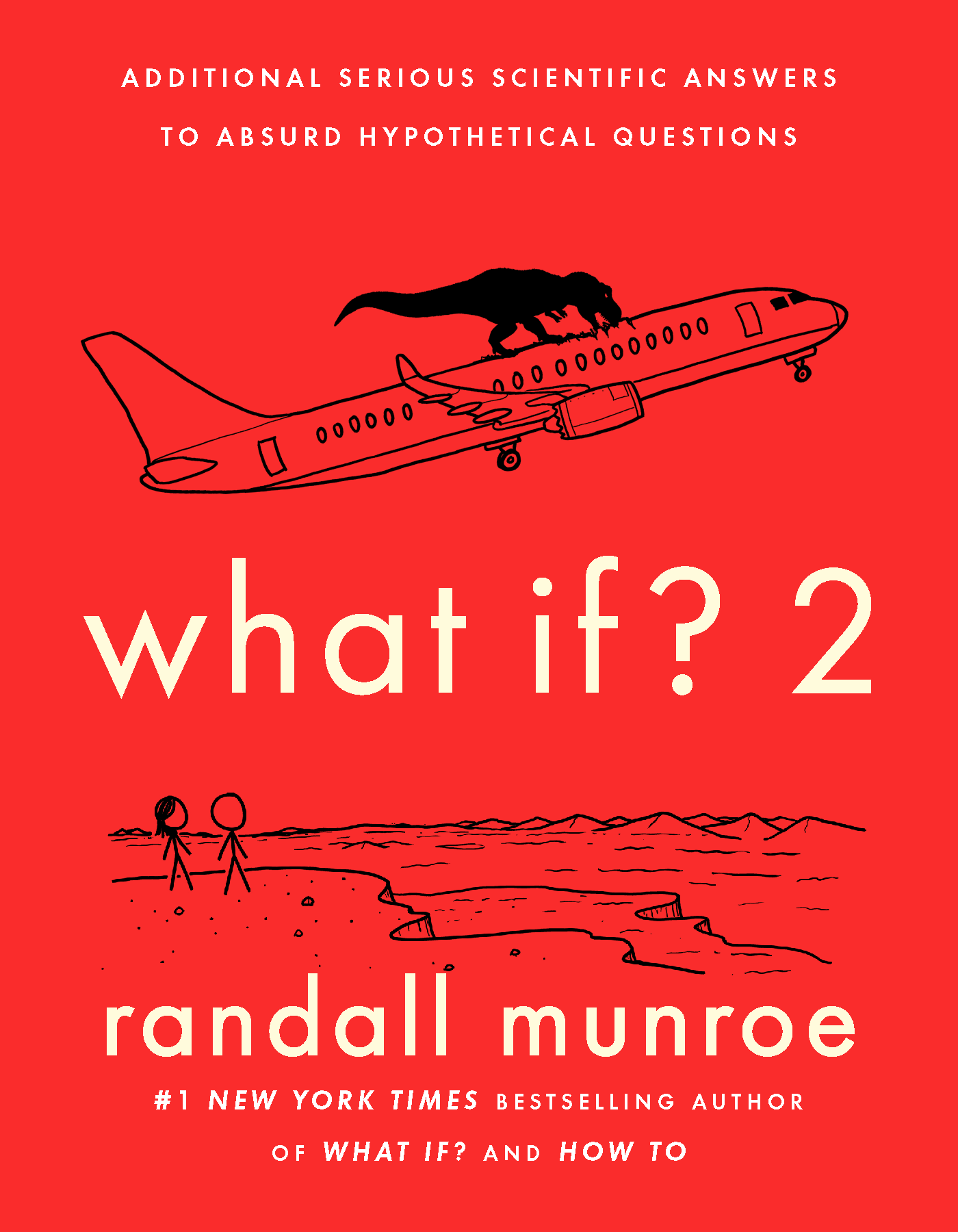
- Munroe, 2022: “What If? 2: Additional Serious Scientific Answers to Absurd Hypothetical Questions”
Additional examples for your project. It is available through the WSU Library by request, but not electronically.
Additional readings and references will be provided as needed. Please see Resources, Readings, and References for details and posts on the Discourse forum.
Student Learning Outcomes#
By the end of this course, students will:
Be “fearlessly curious… ready to attack any problem that comes at [them], and at least get a feel for why things happen” [Mahajan, 2014].
Be able to quickly make order of magnitude estimates.
Be able to break down complex problems into manageable tasks.
Be able to use symmetry, scaling (dimensional analysis), and analogies to simplify complex problems without losing information.
Be able to make approximations, and estimate the errors incurred by such approximations.
Be able to make quick estimates using computational techniques like Monte Carlo, integration, series approximations, splines, etc.
Be able to work in a group, both as a leader, and as a knowledge expert, to solve complex problems.
Be able to communicate effectively and accurately using a variety of modalities.
To following activities will help the students achieve these outcomes:
Estimation Sessions: Each student will lead 1-2 estimation sessions on a topic for which they are not an expert. To complete the estimation, students must therefor organize and draw upon the expertise of a group or the class. This will give students the experience of collaboration, communication, critical thinking & problem solving, and leadership – soft skills that are invaluable for their careers.
Experiments: Where possibly, we will attempt to perform simple experiments to test and refine our estimations. See e.g. Assignments.
Reflection: As a key part of the course, students regularly will reflect on their own paths to mastery in their lives to encourage self-awareness & growth. Mastery is a highly personal but transferable skill: through reflection, students will learn how to apply the techniques that work for them to make rapid progress in other areas, such as the technical field of their dissertation.
This course will not teach mastery of specific material, but will teach the skills needed to rapidly shift from one field to another. This is the essence of estimation: learning how to quickly organize and make sense of new knowledge or data to orient oneself in a new field.
Lab Notebooks: As part of this reflection, students should keep a “Lab Notebook” for the course in which they document their progress. This may be physical, or electronic. Students should use this notebook to make estimates, ask and refine questions, and collect information. This will provide a source of material that can be used in the final project.
Final Project: Students will to write an article in the spirit and style of the book What It? in which they provide supporting estimates to answer an interesting question for a general audience. This will help students gain the ability to communicate effectively about a technical topic like their research to prospective employers, for public outreach, or to attract funding.
For more details about how the activities in this course will prepare you for a successful career, see Career Ready, World Ready.
Expectations for Student Effort#
As per WSU policy, for each hour of lecture equivalent, all students should expect to have a minimum of two hours of work outside class. However, the intent of this course is to minimize the amount of required work outside of class by providing time in class to complete most of the requisite material. Students are expected to use the additional time outside of class applying and mastering this material in their research, and lives.
Students are expected to keep up with readings, and other material assigned in class.
Assessment and Grading Policy#
Regular attendance and participation is required to pass the course. In addition, students are required to keep a “lab notebook” where they will document their progress in the course. Students that regularly attend class, participate in class discussions, and keep their notebook up to date will receive at least a B. Students who also complete a satisfactory project will receive an A.
Attendance and Make-up Policy#
While there is no strict attendance policy, students are expected attend an participate in classroom activities and discussion. Students who miss class are expected to cover the missed material on their own, e.g. by borrowing their classmates notes, reviewing recorded lectures (if available), etc.
Course Timeline#
- Dimensional Analysis, Brainstorming, and Mastery
Introduction.
Essay: Describe something you have mastered.
Estimation Skills: Dimensional analysis; Geometry of the derivative.
- Probability:
Essay: Tell us about your areas of expertise and skills.
Estimation Skills: Probabilistic reasoning; Fourier transform.
- Energy:
Essay: Tell us what you are interested in.
Estimation Skills: Energy; Circuits; Oscillators;
- Invariants:
Estimation Skills: Invariants; Proving algorithmic correctness;
- Thermodynamics:
Estimation Skills: Energy units; Thermal equilibrium; Radiation
- Astronomy and Astrophysics:
Estimation Skills: Orbits (Kepler’s Law); Lumping; Easy cases; Spring models.
- Data Fitting and Uncertanties:
Errors and uncertainties.
Estimation Skills: Probabilistic reasoning; Bayes’ Theorem; Monte Carlo
- Additional topics and student-led estimation sessions, including:
Traffic flow – estimating from PDEs, method of characteristics
Quantum mechanics (see [Olshanii, 2013])
Estimating the yield of the Trinity explosion
Estimation Skills: Method of characteristics; Variational bounds
Projects Due
Thanksgiving Break – No Classes
- Future Directions
Braininstorming big questions.
Ideas for research, papers, and future collaborations.
Other Information#
Policy for the Use of Large Language Models (LLMs) or Generative AI in Physics Courses#
The use of LLMs or Generative AI such as Chat-GPT is becoming prevalent, both in education and in industry. As such, we believe that it is important for students to recognize the capabilities and inherent limitations of these tools, and use them appropriately.
To this end, please submit 4 examples of your own devising:
Two of which demonstrate the phenomena of “hallucination” – Attempt to use the tool to learn something you know to be true, and catch it making plausible sounding falsehoods.
Two of which demonstrate something useful (often the end of a process of debugging and correcting the AI).
Note: one can find plenty of examples online of both cases. Use these to better understand the capabilities and limitations of the AIs, but for your submission, please find your own example using things you know to be true. If you are in multiple courses, you may submit the same four examples for each class, but are encouraged to tailor your examples to the course.
Being able to independently establish the veracity of information returned by a search, an AI, or indeed any publication, is a critical skill for a scientist. If you are the type of employee who can use tools like ChatGPT to write prose, code etc., but not accurately validate the results, then you are exactly the type of employee that AI will be able to replace.
Any use of Generative AI or similar tools for submitted work must include:
A complete description of the tool. (E.g. “ChatGPT Version 3.5 via CoCalc’s interface” or Chat-GPT 4 through Bing AI using the Edge browser”, etc.)
A complete record of the queries issued and response provided. (This should be provided as an attachment, appendices, or supplement.)
An attribution statement consistent with the following: “The author generated this <text/code/etc.> in part with <GPT-3, OpenAI’s large-scale language-generation model/etc.> as documented in appendix <1>. Upon generating the draft response, the author reviewed, edited, and revised the response to their own liking and takes ultimate responsibility for the content.”
Violation of this policy may result in failure of the assignment or course.
Academic Integrity#
You are responsible for reading WSU’s Academic Integrity Policy, which is based on Washington State law. If you cheat in your work in this class you will:
Fail the course.
Be reported to the Center for Community Standards.
Have the right to appeal the instructor’s decision.
Not be able to drop the course or withdraw from the course until the appeals process is finished.
If you have any questions about what you can and cannot do in this course, ask your instructor.
If you want to ask for a change in the instructor’s decision about academic integrity, use the form at the Center for Community Standards website. You must submit this request within 21 calendar days of the decision.
University Syllabus#
Students are responsible for reading and understanding all university-wide policies and resources pertaining to all courses (for instance: accommodations, care resources, policies on discrimination or harassment), which can be found in the university syllabus.
Students with Disabilities#
Reasonable accommodations are available for students with a documented disability. If you have a disability and need accommodations to fully participate in this class, please either visit or call the Access Center at (Washington Building 217, Phone: 509-335-3417, E-mail: mailto:Access.Center@wsu.edu, URL: https://accesscenter.wsu.edu) to schedule an appointment with an Access Advisor. All accommodations MUST be approved through the Access Center. For more information contact a Disability Specialist on your home campus.
Campus Safety#
Classroom and campus safety are of paramount importance at Washington State University, and are the shared responsibility of the entire campus population. WSU urges students to follow the “Alert, Assess, Act,” protocol for all types of emergencies and the “Run, Hide, Fight” response for an active shooter incident. Remain ALERT (through direct observation or emergency notification), ASSESS your specific situation, and ACT in the most appropriate way to assure your own safety (and the safety of others if you are able).
Please sign up for emergency alerts on your account at MyWSU. For more information on this subject, campus safety, and related topics, please view the FBI’s Run, Hide, Fight video and visit the WSU safety portal.
Students in Crisis - Pullman Resources#
If you or someone you know is in immediate danger, DIAL 911 FIRST!
Student Care Network: https://studentcare.wsu.edu/
Cougar Transit: 978 267-7233
WSU Counseling and Psychological Services (CAPS): 509 335-2159
Suicide Prevention Hotline: 800 273-8255
Crisis Text Line: Text HOME to 741741
WSU Police: 509 335-8548
Pullman Police (Non-Emergency): 509 332-2521
WSU Office of Civil Rights Compliance & Investigation: 509 335-8288
Alternatives to Violence on the Palouse: 877 334-2887
Pullman 24-Hour Crisis Line: 509 334-1133