
Lecture Notes - Fall 2024#
These are lecture notes about what we did in class in the Fall 2024 offering of the course.
Mon 2 Dec 2024#
Lumping:
Bending of light (example from sailboat).
Dissipation of energy by viscosity.
Mountain on Mars.
Neutron star.
Probabilistic reasoning:
How long until an odor molecule reaches you?
Thermal conductivity of mercury (why is it so low?) \(\qty{8.3}{W/m/K}\) vs copper \(\qty{380}{W/m/K}\).
Easy cases:
Regimes and limiting cases:
Dimensional analysis.
Rolling down a plane (8.3.1.1)
Spring models:
Musical notes from beams and strings.
Gravitational radiation.
Blue skies. (How safe is it to look at the sun?)
Mon 4 Nov 2024#
Dimensions:
Kepler. Sun, Moon, Earth, etc.
Thermal Equilibrium: Gibbs - see [Schrödinger, 1952].
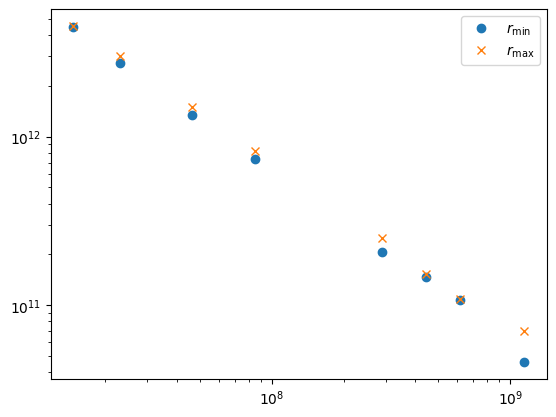
data = np.array([
   [4.6001e10, 6.9818e10, -1.1462e9],
   [1.0748e11, 1.0894e11, -6.1339e8],
   [1.4710e11, 1.5210e11, -4.4369e8],
   [2.0666e11, 2.4923e11, -2.9119e8],
   [7.4067e11, 8.1601e11, -8.5277e7],
   [1.3498e12, 1.5036e12, -4.6523e7],
   [2.7350e12, 3.0063e12, -2.3122e7],
   [4.4598e12, 4.5370e12, -1.4755e7]])

r_min, r_max, V = data.T

fig, ax = plt.subplots()
ax.plot(abs(V), r_min, 'o', label='$r_{\min}$')
ax.loglog(abs(V), r_max, 'x', label='$r_{\max}$')
ax.legend()
<matplotlib.legend.Legend at 0x7844b5edbdd0>
Wed 30 Oct 2024#
Dimensions:
Find meaningful comparisons:
Energy consumption?
Solar power at Earth’s surface: 10^{17}W
Problems:
Estimate the solar power (in watts) falling on the earth’s surface. (ANS. \(2\times 10^{17}\)W.)
Thermal Equilibrium: Gibbs - see [Schrödinger, 1952].
Radiation pressure \(p = u/3\).
Mon 28 Oct 2024#
Discussed projects.
What If?
Language.
Wed 18 Sep 2024#
Invariants:
Example algorithm for fib(n):
Wed 11 Sep 2024#
LRC circuits. Driven oscillator.
Problem: Can a 9V battery launch itself into space?
Induction demo.
Mon 9 Sep 2024#
Energy in bonds.
Oscillators.
Wed 28 Aug 2024#
Example: Area of an ellipse in terms of the radii.
Random variables.
How to add (how do errors add in physics lab?):
\[\begin{gather*} z = x + y, \qquad \delta z = \sqrt{(\delta x)^2 + (\delta y)^2}. \end{gather*}\]Leads to law of large numbers:
Birthday problem: \(p\approx 0.315\). How many trials do we need to estimate this with a 95%CI for an error of \(\pm 0.05\)?
Recall that for a binomial distribution with probability \(p\) we have \(\sigma = \sqrt{p(1-p)}\) while the error of the mean should be \(\sigma_{\bar{x}} \approx \sigma / \sqrt{N_t}\). For a 95%CI, we should have \(2\sigma_{\bar{x}} = 0.05\) giving \(N_t \approx 4\sigma^2/0.05^2 \approx 350\).
Background: Need Fourier transform. Think of basis functions as plane waves:
\[\begin{gather*} \DeclareMathOperator{FT}{\mathcal{F}} f(x) = \int_{-\infty}^{\infty} \frac{\d{k}}{2\pi}\; f_k e^{\I k x} = \FT^{-1}[f_k]\\ f_k = \FT[f] = \int_{-\infty}^{\infty}\d{x}\; e^{-\I k x} f(x),\\ \end{gather*}\]Convolution Theorem:
\[\begin{gather*} \FT[f*g] = \FT\left[\int f(y-x)g(x)\d{x}\right] = \FT[f]\; \FT[g] \end{gather*}\]\[\begin{gather*} \braket{x|k} = e^{\I k x}\\ \mat{1} = \int_{-\infty}^{\infty}\d{x} \ket{x}\bra{x} = \int_{-\infty}^{\infty}\frac{\d{k}}{2\pi} \ket{k}\bra{k},\\ \braket{p|k} = \braket{p|\mat{1}|k} = \int_{-\infty}^{\infty} \d{x}\braket{p|x}\braket{x|k} = \int_{-\infty}^{\infty} \d{x}e^{-\I p x}e^{\I k x} = \int_{-\infty}^{\infty} \d{x}e^{\I p x(k-p)} = (2\pi)\delta(k-p). \end{gather*}\]\[\begin{gather*} \delta(x) = \int_{-\infty}^{\infty} e^{\I k x}\frac{\d{k}}{2\pi}, \qquad 2\pi\delta(k) = \int_{-\infty}^{\infty} e^{\I k x}\d{x}. \end{gather*}\]
Mon 26 Aug 2024#
Discussed probability, PDFs etc. See Probability.
Discussed Dirac Delta Function, especially how to use \(\delta\bigl(g(x)-g_0\bigr)\).
Mentioned combining PDFs.
Wed 21 Aug 2024#
Fun problem:
\[\begin{gather*} a+b+c = 0\\ a^2+b^2+c^2 = \sqrt{74}\\ a^4 + b^4 + c^4 = ? \end{gather*}\]Question:
What is the probability of two people in the room sharing a birthday? (There were \(N=17\) in the class, and none shared a birthday)
If we did an experiment where everyone randomly chose a birthday and we repeated again, how many times would we have to run this to get a good estimate of the probability?
Insight: The probably of any one person having a birthday is \(1/D = 1/365\), but we are really looking at all pairs of people. There are \(N \choose 2 = N(N-1)/2 \sim N^2\) such pairs, thus we might expect \(p \sim N^2/2/D \sim (17)^2/2/365 \sim 0.4\). (The correct probability is \(p=0.315\) in this case.)
Mon 19 Aug 2024#
Introductions: students introduced themselves, their backgrounds, expertise, and interests.
Overview of iSciMath program and the motivation for the course.
Problem: How long will one wait for parking in the lot outside of the Moscow farmers market? (5min alone / 10min in groups)
Interesting points:
Vendors might take longer that customers.
There is a 3h maximum parking limit.
Can we model the vacancy as a distribution? If so, the relevant question might be – what is the distribution of the minimum of \(N\) samples from a given distribution? (Fun little problem. Hint: it involves the cumulative distribution function \(C(x) = \int_{-\infty}^{x}P(x)\d{x}\).
Quick review and discussion of the textbook topics.
Discussion of dimensional analysis.
Application to a pendulum.
Question: How high can an animal of height \(l\) jump? (I.e., how does the height \(h\) an animal can jump depend on the linear size of the \(l\) animal?)
Dimensionally, we worked out that roughly, energy must be conserved, so the work done \(Fl \approx mgh\) must be related to the potential energy gained:
\[\begin{gather*} h \propto \frac{Fl}{mg}. \end{gather*}\]We estimated that the mass of an animal scales like the volume \(m \propto l^3\) but left as an exercise how the force \(F\) scales?
Mathematics Portion
Consider the geometry of the derivative. The derivative gives a linear approximation that can be bounded arbitrarily well by a cone of decreasing angle.
To Do
Register on the iSciMath Discourse: <discourse.iscimath.org>.
Establish a “Lab Notebook” for the course where you record your thoughts, workings, questions, etc. I would like to see this twice during the course (will be returned).
Reading: Mahajan: I.1: “Divide and conquer”
Essay: Describe something you have mastered. What does mastery mean? How did you achieve mastery? What works for you? What does not? How long did it take? This need not be technical – music, sports, cooking, hobbies, crafts, etc. are all great sources of material. The goal is for you to identify what works for you, and then apply that to your technical training in this course and your program of study.
Podcast: How to Become Great at Just About Anything - Freakonomics. Relevant discussion of the 10,000 rule, deliberate practice, etc. How does your experience relate to what is discussed in this podcast?